Why Is My Pressure Washing Leaving Streaks on Marietta Driveways?
Key points
- Stripes are height marks: a fan jet cleans hard at six inches and barely at eighteen.
- More pressure etches older and clay-stained concrete — and etched bands re-soil faster and darker.
- Red-clay film needs pre-treatment and algae needs treatment, not a closer pass.
- A rotary surface cleaner holds jets at a fixed height, so every inch gets the same clean.
The stripes are height marks, not dirt
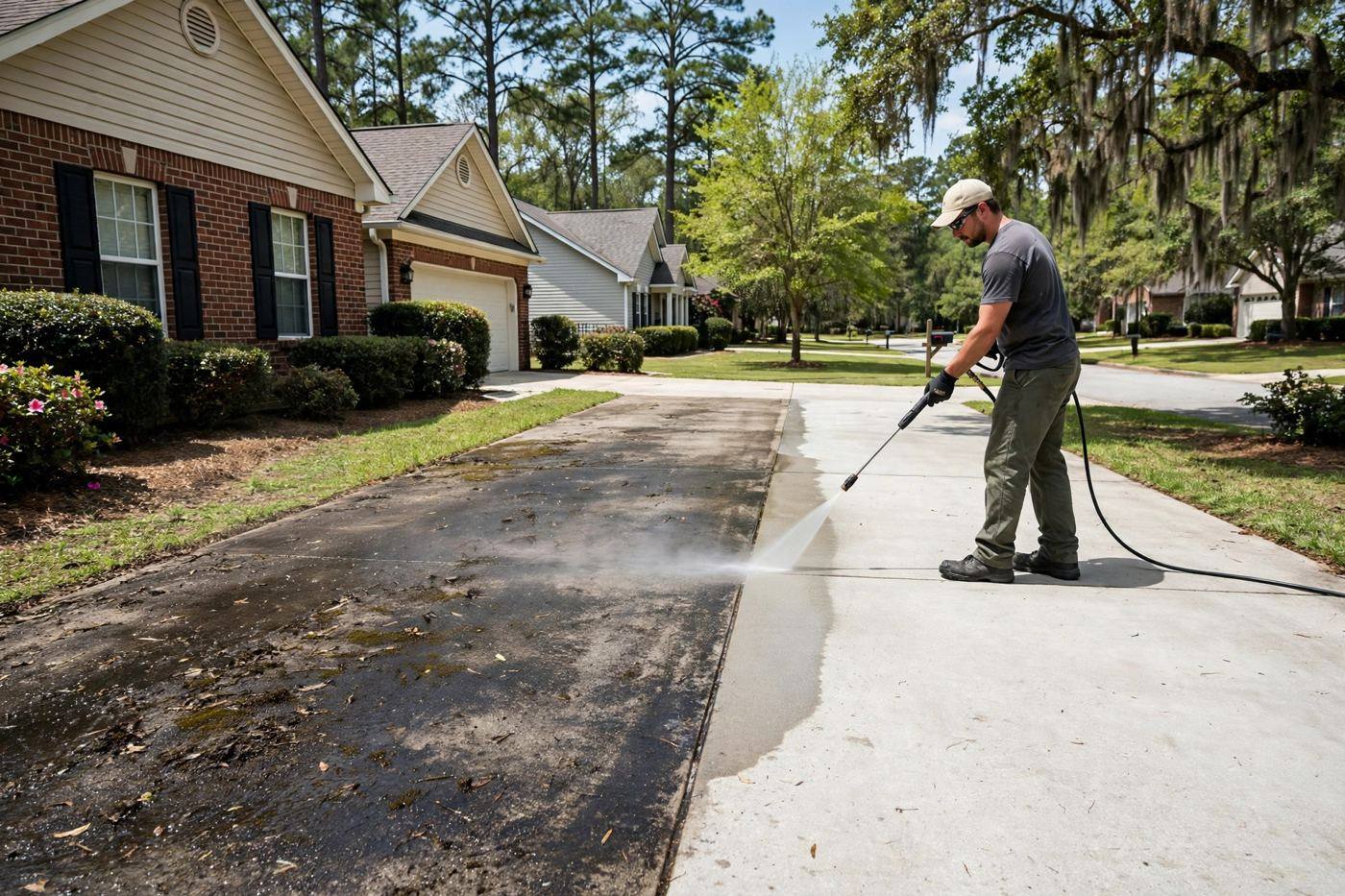
If your driveway looks clean wet and striped dry, you didn't miss dirt — you varied the wand height. A pressure-washer fan jet cleans aggressively at six inches and barely touches at eighteen, so every hand-swept arc leaves its own clean band. Dry, the overlaps read as zebra stripes, and the first rain makes them obvious.
Marietta concrete adds two local wrinkles: red-clay film that needs pre-treatment, not more pressure, and algae in shaded sections that survives a quick pass and re-greens the 'clean' bands within weeks.
Why more pressure makes it worse
The instinct is to get closer and slower. On clay-stained or older concrete that etches the surface — you can literally write your name in a driveway with a zero-degree tip — and etched bands hold dirt faster than the rest, so the stripes come back darker. Pressure is the last variable to raise, not the first.
How professionals wash stripe-free
A rotary surface cleaner holds twin jets at a mechanically fixed height and moves at walking pace, so every square inch gets the same treatment. Before it runs, the surface is pre-treated: algae treatment for the green sections, a clay-and-rust treatment for the orange shadowing Marietta soil leaves, degreaser on oil spots. Edges and joints are detailed afterwards with a wand at a sensible distance.
That's exactly the process on our pressure washing and driveway and concrete cleaning pages — and why a standard Resiclean job runs 2–4 hours: most of the quality is in the prep, not the rinse.
When to just book it
If your drive is two cars wide, shaded and clay-stained, a rental machine plus chemicals costs most of a professional visit and a full Saturday, with the stripe risk thrown in free. Get a free estimate and compare honestly — Dillon will tell you if your concrete is an easy DIY.
Reading your stripes like a diagnosis
The pattern in the concrete tells you which mistake made it. Even, repeating arcs across the whole drive mean wand height wandered with each sweep — the classic height-mark stripe. A single darker band along the garage apron or the street edge usually means the pass slowed or stopped there, or that runoff from the untreated section re-soiled the finished one. Stripes that were invisible on wash day but bloomed green within weeks are different again: the algae was bleached, not treated, and the living film in the shaded bands simply regrew — common under Marietta's oak canopy, where north-facing concrete can stay damp for days after a summer storm.
Red clay writes its own signature. The iron-rich soil across Cobb County leaves an orange-brown shadow that pressure alone barely touches, so homeowners chase it closer and slower until the surface itself is etched — after which the etched lanes hold dirt faster than the surrounding concrete and the stripes return darker every season. Clay film answers to a matched treatment and dwell time, not to proximity.
Work in the right order and the diagnosis becomes the cure: treat algae and clay first, let both dwell in shade, run the surface cleaner at a steady walking pace with overlapping passes, then detail edges and expansion joints last. If your stripes match the etched pattern, stop washing and get an honest assessment — further pressure only deepens the lanes. Etched lanes cannot be washed back to flat; they can only be evened honestly and then maintained gently, which is one more reason the first wash on older concrete should be the careful one.
Frequently asked questions
Why do pressure-washing stripes show up after the concrete dries?
Because a fan jet's cleaning power falls off sharply with distance. Wet concrete hides the variation; dry, every hand-swept arc reads as its own clean band where the wand passed closer, and the first rain makes the overlaps obvious.
Will higher pressure remove the stripes?
No — it usually makes them permanent. On older or clay-stained concrete, getting closer etches the surface, and etched bands hold dirt faster than the rest, so the stripes come back darker. Pressure is the last variable to raise, not the first.
How do professionals wash a driveway stripe-free?
Pre-treatment first — algae treatment for green sections, a clay treatment for orange shadowing, degreaser on oil — then a rotary surface cleaner whose twin jets sit at a fixed height, moved at a steady walking pace, with edges detailed afterwards.
Related reading
- Best Way to Clean Concrete Driveways Without Harsh Chemicals
- Spring Cleaning Checklist for East Cobb Homes After Pollen Season
- Window Cleaning Cost in Marietta, GA: Three Worked Examples (2026)
- Pressure Washing — the Resiclean service page for this topic
Sources
- Cobb County–Marietta Water Authority — Annual Water Quality Information
- Cobb County Government
- Georgia Environmental Protection Division (GA EPD)
Next step: get a free, firm estimate for your own home — call (770) 846-5651 or send the form. See what window cleaning costs in Marietta and what customers say.
Free estimates, owner-operated
Resiclean · 4669 S Landing Dr, Marietta, GA 30066 · Open 7 am–8 pm · 7 days a week
Call (770) 846-5651 →